
 Additional settings for Safari Browser.


Measles Information
Measles Information
Measles is a highly contagious viral infection. It spreads easily through the air when an infected person breathes, talks, coughs or sneezes, and the virus can linger in the air or on surfaces for up to two hours.
Visit the Centers for Disease Control for more information on measles.
Measles: Frequently Asked Questions
-
Students entering Kindergarten are required to have the following immunizations:
- 5 DTaP/DT
- 4 Polio
- Measles, Mumps, Rubella (MMR) -Typically at 12 to 15 months and prior to entering kindergarten
- 3 Hepatitis B
- 2 Hepatitis A
- 2 Varicella (chickenpox)
Students entering 7th grade or higher, are required to have the following immunizations, in addition to all previously required vaccinations:- 1 Meningococcal Vaccine (given on or after the 10th birthday).
- 1 Tdap Vaccine (given on or after the 10th birthday).
- HPV Vaccine is available, but not a requirement.
Parents may access their student’s immunization record using the Docket app. -
- Measles spreads through the air when an infected person coughs or sneezes.
- People can get measles by being in a room where a person with measles has been.
- The virus stays in the air for up to 2 hours after that person has left.
-
First symptoms
- Fever, typically 101°F (38.3°C) or higher)
- Cough
- Runny nose
- Red, watery eyes
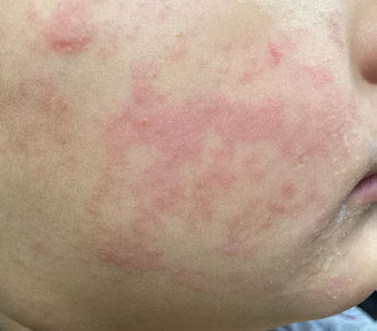
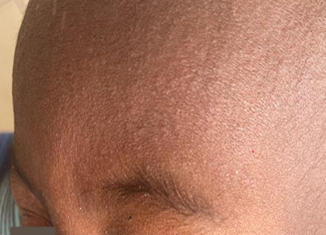
2 to 5 days later, the rash appears.- Usually begins as flat, red spots that start on the face at the hairline and spread down to the neck, trunk, arms, legs, and feet.
- Small, raised bumps may appear on top of the red spots.
- Fever may get higher than 104°F.
-
- Hospitalization: About 1 in 5 unvaccinated people in the U.S. who get measles are hospitalized.
- Pneumonia: As many as 1 out of every 20 children with measles gets pneumonia, the most common cause of death from measles in young children.
- Encephalitis: About 1 child out of every 1,000 who get measles will develop encephalitis (swelling of the brain). This can lead to convulsions and leave the child deaf or with intellectual disability.
- Death: Nearly 1 to 3 of every 1,000 children who become infected with measles will die from respiratory and neurologic complications.
- Complications during pregnancy: If you are pregnant and have not had the MMR vaccine, measles may cause premature birth or a low-birth-weight baby.
- Long-term complications: Subacute sclerosing panencephalitis (SSPE) is a very rare, but fatal disease of the central nervous system. It results from a measles virus infection acquired earlier in life.
-
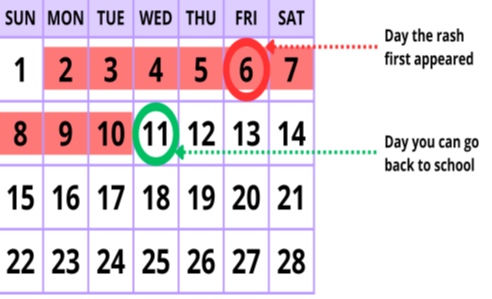
Four days before a person gets the rash until four days after the rash starts. (see calendar below) People are contagious before the rash appears, or while the person is experiencing the early symptoms.
This is why it is important for students and staff who are not feeling well to stay home. Send ALL students who are feeling sick home.
-
Your student must isolate at home and stay away from all public places (including school) until it has been 4 days since the rash first appeared.
- The day the rash started counts as day Zero.
- The day after the rash appeared is day One.
- The person should isolate through day 4.
-
The school nurse will:
- Contact the local health department and the support school as needed.
- Provide the Health Department with the names and student information (parent contact info, MMR vaccination status) of all students who were in the school on the days of concern.
The Health Department will:
- Contact parents to gather more information.
- Calculate and provide return to school dates to parents and schools.
- Determine exclusion periods for students who are vaccine exempt or unvaccinated.
- Send parent information letters to the school, then send them to parents.
-
Students who have TWO Measles, Mumps, Rubella (MMR) vaccinations:
- May continue to attend school as usual.
- Parents should watch for fever or rash for the next 21 days.
Students who have ONE Measles, Mumps, Rubella (MMR) vaccination:
- May continue to attend school, but should get the 2nd dose of MMR if it has been at least 28 days since the first dose.
- Parents should watch for fever or rash for the next 21 days.
If symptoms occur, the student’s parent should notify their physician or a healthcare provider for a test for measles. -
A Student who has received no prior MMR vaccinations may not be able to return to school until 21 days have passed since the last day of exposure in a building/home, etc., with a contagious person.
Students may return to school if they get a dose of MMR within 72 hours of exposure.
-
Students who are excluded will receive asynchronous online instruction from the school.
-
- To prevent spreading measles, the student will be asked to wear a mask when around others, while waiting for parents pick up.
- The student will isolate in the sick room. They may remove their mask while in there alone.
- School staff who attend to students while awaiting parent pick up should:
- Have Immunity to measles (2 MMR vaccines or a documented Measles titer)
- Not have a diagnosis of a medical condition that causes them to have a compromised immune system.
- The school will notify the nurse, who will contact the health department.
- The school custodian will be notified to disinfect the school.
-
- The most effective way to protect children from getting measles is to vaccinate them with two MMR (measles, mumps, and rubella) vaccines.
- The first dose of the MMR vaccine should be given when the child is 12 to 15 months old, and the second dose between ages 4 and 6.
- After two doses, the MMR vaccine is about 97% effective at preventing measles.
Additional protective measures
- Practice good hygiene: Wash hands frequently with soap and water and cover coughs and sneezes with a tissue or elbow.
- Avoid sick individuals: Limit close contact with people who are sick.
- Disinfect surfaces: Regularly clean and disinfect frequently touched surfaces.
- Limit exposure to crowds: Especially for babies, try to limit their exposure to large crowds.
- Keep your student home when they are feeling sick.
Additional Information Resources
State of Utah Measles Response Page
State of Utah K-12 Schools Measles Checklist